The Cell Counting Kit-8 (CCK-8), featuring the WST-8 reagent, is a highly efficient and sensitive assay for assessing cell viability and proliferation. Its ease of use, accuracy, and non-radioactive nature have made it a staple in laboratories worldwide. The kit provides a rapid and straightforward approach to measuring the health and growth of cells, essential in applications such as drug development, toxicology, and cell biology research.

How CCK-8 Works: Mechanism of Action
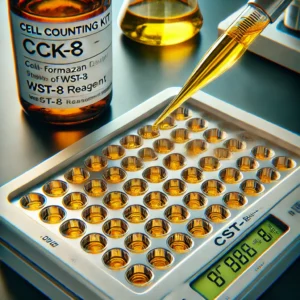
CCK-8 employs WST-8 (Water-Soluble Tetrazolium-8), a salt that is reduced by cellular dehydrogenases present in metabolically active cells. The reduction reaction results in the formation of a water-soluble formazan dye, which is bright yellow. The amount of formazan produced is directly proportional to the number of viable cells, as dead or non-proliferative cells lack the metabolic activity required for the reduction process.
For those interested in the chemical aspects of this reaction, you can explore the biochemistry of tetrazolium salts on the National Center for Biotechnology Information (NCBI).
Advantages of Using CCK-8 Over Traditional Methods
- Enhanced Sensitivity: CCK-8’s formulation allows it to detect subtle changes in cell viability, making it more sensitive than traditional assays like MTT or XTT. For more details on sensitivity comparisons, visit the European Molecular Biology Organization (EMBO).
- No Radioactive Material: Unlike tritiated thymidine assays, CCK-8 is safer and more environmentally friendly as it does not use radioactive substances.
- Water-Soluble Product: The formazan produced is water-soluble, eliminating the need for additional solubilization steps that are common in other assays like MTT.
- Non-Toxic Reagent: The WST-8 reagent is non-toxic to cells, allowing the same sample to be used for further analyses or experiments.
Applications of CCK-8 in Research and Industry
- Drug Screening: Researchers use CCK-8 to screen potential drug compounds for cytotoxic effects. It helps determine the half-maximal inhibitory concentration (IC50), a critical value for assessing drug efficacy. The U.S. Food and Drug Administration (FDA) provides guidance on how these assays are used in pharmaceutical development.
- Cancer Research: The kit is particularly useful for studying cancer cell proliferation, where it helps evaluate the effectiveness of anti-cancer therapies. Learn more about this application on the American Cancer Society (ACS).
- Stem Cell Research: Understanding cell proliferation and viability is essential in stem cell studies, and CCK-8 is widely adopted to monitor the growth and differentiation of stem cells. The National Institute of Health (NIH) provides resources on stem cell research applications.
- Toxicology Studies: In toxicology, CCK-8 is used to determine the cytotoxic effects of chemicals and environmental pollutants on different cell types. The Environmental Protection Agency (EPA) outlines standards for such testing.

Protocol: Step-by-Step Procedure for CCK-8 Assay
- Cell Preparation: Seed cells in a 96-well plate at the desired density. Ensure uniform cell distribution and allow the cells to adhere overnight if required.
- Addition of Reagent: Add 10 µL of CCK-8 solution to each well containing 100 µL of culture medium. This reagent does not disturb the cells, making the process simple and mess-free.
- Incubation: Incubate the plate for 1 to 4 hours at 37°C, depending on the cell line and experimental requirements. For more specific protocol guidance, visit the World Health Organization (WHO).
- Measurement: Measure the absorbance at 450 nm using a microplate reader. The optical density (OD) reading is proportional to the number of viable cells.
Data Interpretation and Analysis
The absorbance data from CCK-8 assays are straightforward to interpret. Typically, higher OD values indicate a higher number of viable cells. Researchers often plot these readings against known cell concentrations to create a standard curve, which can be used to estimate cell numbers in unknown samples.
For advanced statistical analysis and data presentation, refer to tutorials available on PubMed Central (PMC).
Factors Affecting the CCK-8 Assay
While the CCK-8 assay is robust, several factors can influence its performance:
- Cell Density: High or low cell densities can skew results, leading to non-linear responses. Maintaining consistent seeding densities is essential for accurate comparisons.
- Incubation Time: Prolonged incubation can lead to the overdevelopment of color, resulting in inaccurate absorbance readings. It is crucial to optimize incubation times for each cell type.
- Media Components: Some cell culture media may interfere with the assay, particularly if they contain reducing agents like phenol red. The National Agricultural Library (NAL) offers insights into cell culture best practices.
Common Challenges and Solutions
- Background Interference: Occasionally, background noise can arise from media components or reagents. It is advisable to include a blank control (medium with CCK-8 but no cells) to account for this.
- Inconsistent Results: If results vary between experiments, consider checking for consistent cell seeding, precise pipetting, and stable environmental conditions during incubation.
For troubleshooting, consult resources from the European Centre for Disease Prevention and Control (ECDC).
Comparisons with Other Cell Viability Assays
The CCK-8 assay is often compared to other tetrazolium-based assays such as MTT, XTT, and MTS. While all of these assays are designed to measure cell viability, CCK-8 stands out for its ease of use and improved sensitivity. Unlike MTT, which forms an insoluble formazan product requiring solubilization, CCK-8’s water-soluble nature simplifies the workflow. To read more about these comparisons, check publications on PubMed.
Conclusion
The Cell Counting Kit-8 (CCK-8) is an indispensable tool for researchers across diverse fields, including oncology, toxicology, and regenerative medicine. Its non-toxic, sensitive, and easy-to-use characteristics make it an ideal choice for routine and high-throughput screening. By simplifying the workflow and providing reliable results, CCK-8 allows scientists to focus on the experimental variables that truly matter. To learn more about cell viability assays, visit the National Institutes of Health (NIH) and World Organisation for Animal Health (OIE).
By adopting advanced yet simple assays like CCK-8, researchers can streamline their workflows, enhance reproducibility, and accelerate the discovery of new therapeutic compounds. For more information on related technologies, browse through resources from Centers for Disease Control and Prevention (CDC), Food and Drug Administration (FDA), and National Center for Biotechnology Information (NCBI).